
Reduce Fuel Consumption. Build Resilience Against Bunker Price Volatility


With bunker prices being volatile and soaring recently, shipowners are under increasing pressure to reduce both fuel consumption and operational risk.
While much attention is given to propulsion efficiency, electrification and renewable sources like wind-assisted propulsion, the vessel's central heating system remains an overlooked opportunity for significant savings.
An Integrated Central Heating System (ICHS) typically integrates heat recovery from main and auxiliary engines, but such a system will always need a redundant source of heating, to manage base load. In specifications we typically ss that this is either specified as an electric or oil-fired boiler.
But herein lies an important fact: Despite their high efficiencies (99-99%), electric boilers are not necessarliy the most fuel-efficient option on a ship. Unlike shore-based systems powered by renewable electricity, onboard power is mainly generated by diesel gensets, consuming around 200 g fuel per kWh. This means that an electric boiler does not replace fuel consumption - it repackages it through an inefficient conversion chain. See the small calculation example where three heating options fulfilling a heat demand of 100 thermal kWh (t kWh):
- Option 1: Electric boiler (continuously)
- Option 2: Oil fired boiler (continuously)
- Option 3: Oil fired boiler combined with heat recovery 80% of the time
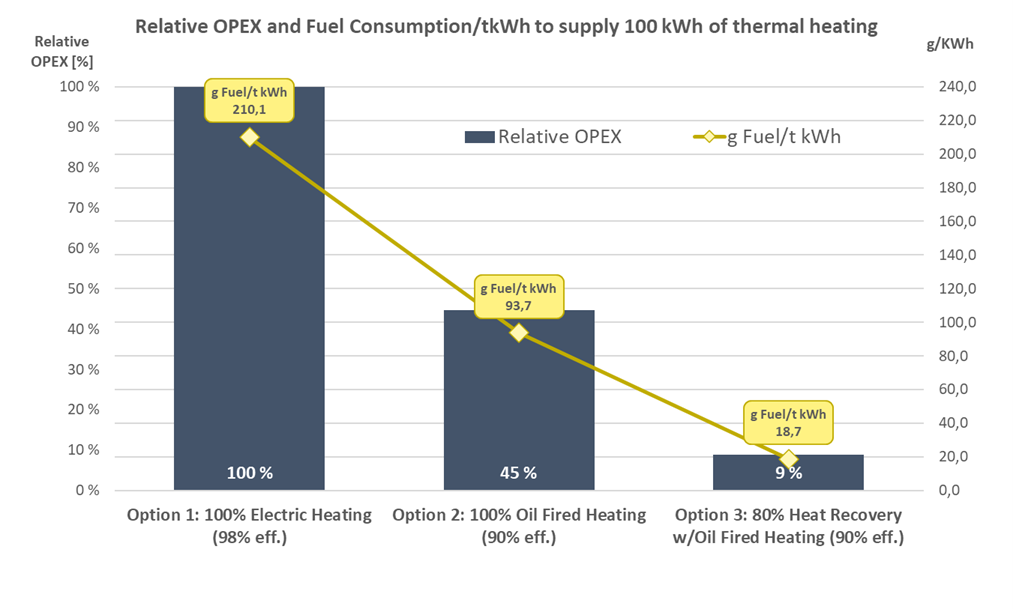
The result speaks for itself: Electric boiler is the most expensive solution in a normal seagoing duty - a total of 210 g fuel is consumed for 100 kWh of thermal power output. With an oil-fired heater integrated in a heat recovery system, the same heat duty can be served with 91% less fuel. (There could of course be arguments for electric heating during port calls (zero engine load), but this can normally be solved by including heating elements to the oil-fired heater).
To convert this fact into tangible impact: We use as an example a typical offshore vessel with an annual total energy consumption of 20 MWh. If we assume 3% (0,6 MWh) of the annual energy consumption is used for onboard heating purposes, we can calculate fuel burn required to deliver 0,6 thermal MWh for each heating option:

If we use the average annual fuel prices for the period 2021-today (figure 1), the three options give the following economic impact (Operating Expenditure (OPEX) if you want):

Accumulated heating cost (OPEX) since 2021 is illustrated.
It is evident from the graph that building resilience against fluctuating fuel prices must involve option 3 (Heat recovery integrated with oil fired heater)
In fact, accumulated over these years, the cost of pure electric heating (option 1) has been 1100% more expensive than option 3, whereas pure oil-fired heating is 500% more expensive

From an economic perspective it is clear. From an environmental perspective it is even more clear. And from a technological and market-based perspective, this is in fact a technology available today at a reasonable cost!
Ulmatec's well-proven ICHS (Integrated Central Heating System) is a closed-loop self-regulating (autonomous) central heating system which integrates any heater for base load, but is tuned to repurposing waste heat from engines and gensets to relevant consumer systems. This will result in fuel savings, and - with our most recent software developments - we can prove it, since we monitor and log the whole process!
Summarized: With Ulmatec ICHS as your next central heating system the result will be:
- Reduced overall fuel consumption
- Reduced emissions of Green House Gases (GHG)
- Lower operating cost
- Improves bunker cost resilience in a volatile fuel market
- Avoid unnecessary electrical load and generator wear.
In a world where every ton of fuel counts, the most effective strategy is not to change the energy carrier - but to use the available energy smarter.
Click here to read more about our Integrated Central Heating System.
